SBME Research Day
SBME Research Day is an opportunity for our community of faculty, trainees, and staff to come together, discuss SBME priorities, and share their research through a poster session, trainee talks, and lunch. Save the date! More event details to come.
Events
Calendar

- This event has passed.
Research Seminar – NeuroString: Soft high-channel count multimodal bioelectronic fiber for sensing in the brain and guts – Dr. Zhenan Bao
Research Seminar – NeuroString: Soft high-channel count multimodal bioelectronic fiber for sensing in the brain and guts – Dr. Zhenan Bao</font color>
Location:
Lecture Theatre B1001, Gordon B. Shrum Building – 6088 University Boulevard, Vancouver BC
Abstract: We are inspired by skin’s ability for sensing external stimuli, such as pressure, pain, and temperature, and translates into spike-train signals. Furthermore, skin is conformable, stretchable, self-healable and biodegradable. The development of electronic materials and systems, inspired by the complexity of skin is a tremendous, unrealized materials challenge. On the other hand, if successful, this can enable a new generation of electronics that will provide high accuracy and high-resolution data about human health and how human interact with surroundings. Taking from this inspiration, my group has developed foundational materials, manufacturing and integration methods to build skin-like sensing systems. Given there is a large demand for minimally invasive, multi-modal sensing and stimulation for both research and clinical applications, we recently developed skin-like 1D bioelectronic fibers, called NeuroString. Existing fibers suffer from high rigidity, low component layout precision, limited functionality, and low density of active components. These limitations arise from the challenge of integrating many components into 1D fiber devices, especially due to the incompatibility of conventional microfabrication methods (e.g., photolithography) with curved, thin and long fiber structures. As a result, limited applications have been demonstrated to date. Our method is based on the concept of transforming a 2D sensing sheet containing microfabricated devices into 1D soft fibers. This approach allows for the fabrication of high-density multimodal soft bioelectronic fibers while enabling precise control on the longitudinal, angular, and radial positioning and distribution of the functional components. Taking advantage of the biocompatibility of our soft fibers with the dynamic and soft gastrointestinal (GI) system, we proceed to show the feasibility of our NeuroString for postoperative multimodal continuous motility mapping and tissue stimulation in awake pigs. We further demonstrate multi-channel single-unit electrical recording in mouse brain for up to 4 months, and a fabrication capability to produce 1280 channels within a 230-micron-diameter soft fiber. Our soft NeuroString fibers hold great promise for minimally invasive implantable electronics, in which myriad functionalities—ranging from sensing and stimulation to therapeutic applications—can be effectively integrated.
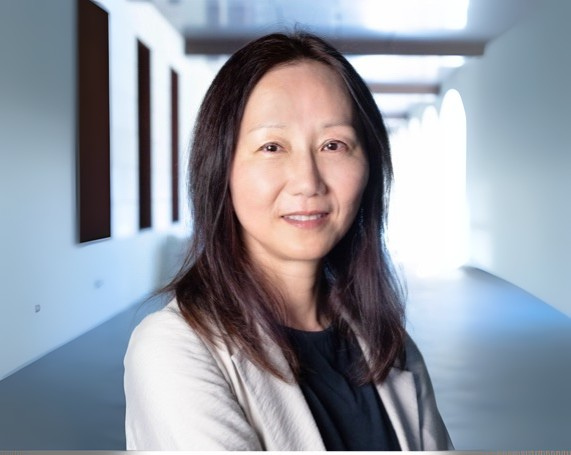
Dr. Zhenan Bao’s Bio: Bao is K.K. Lee Professor of Chemical Engineering, and by courtesy, a Professor of Chemistry and a Professor of Material Science and Engineering at Stanford University. Bao directs the Stanford Wearable Electronics Initiate (eWEAR). She served as the Department Chair of Chemical Engineering from 2018-2022. She is serving as the interim Department Chair from April to September 2025. Prior to joining Stanford in 2004, she was a Distinguished Member of Technical Staff in Bell Labs, Lucent Technologies from 1995-2004. She received her Ph.D in Chemistry from the University of Chicago in 1995.
Dr. Bao is a member of the National Academy of Sciences, the National Academy of Engineering, the American Academy of Arts and Sciences and the National Academy of Inventors. She a foreign member of the Chinese Academy of Science. Dr. Bao is known for her work on artificial electronic skin, which is enabling a new-generation of skin-like electronics for regaining sense of touch for neuro prosthetics, human-friendly robots, human-machine interface and seamless health monitoring devices. She has been named by Nature Magazine as a “Master of Materials”, and is a recipient of the VinFuture Prize Female Innovator 2022, ACS Chemistry of Materials Award 2022, Gibbs Medal 2020, Wilhelm Exner Medal 2018, and L’Oréal-UNESCO For Women in Science Award 2017. Dr. Bao co-founded C3 Nano (acquired by Du Pont) and PyrAmes, which produced materials used in commercial smartphones and FDA-approved blood pressure monitors. Research inventions from her group have also been licensed as foundational technologies for multiple start-ups founded by her students.